

The Illness Trajectory
As a patient’s illness progresses, not only does their physical well-being change, their mental, emotional, and spiritual health may also decline and fluctuate.
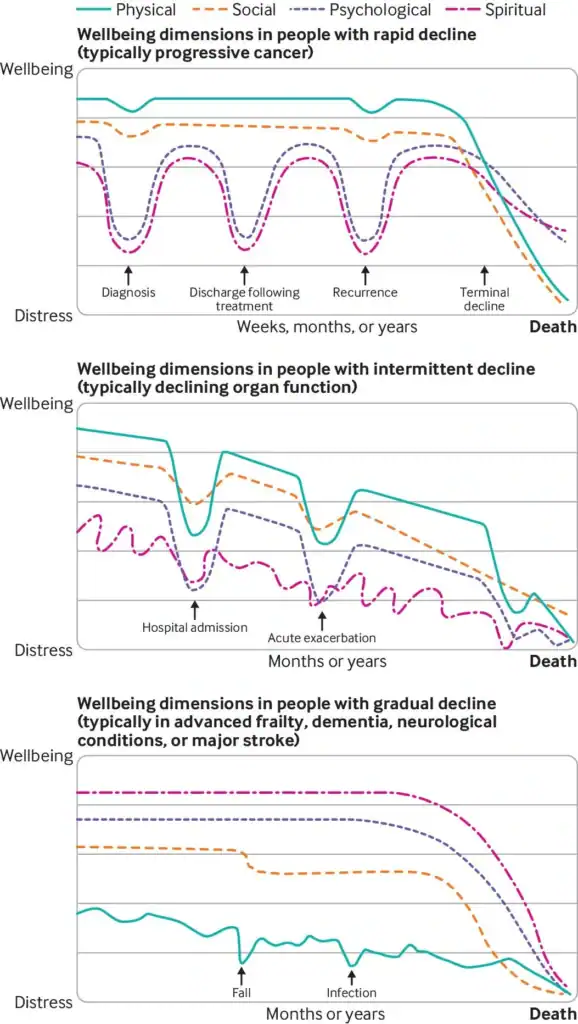
(Murray S A, Boyd K, Moine S, Kendall M, Macpherson S, Mitchell G et al. Using illness trajectories to inform person centred, advance care planning BMJ 2024; 384 :e067896 doi:10.1136/bmj-2021-067896)
In tandem with the changes experienced by the patient, the family and caregivers are inevitably also affected. They may experience corresponding physical, psychosocial and spiritual impacts. Family members who provide care for the patient may experience physical and emotional strain, increasing their risk of health problems. They may also experience changes to their daily lives as they adjust their schedules, roles and responsibilities to care for the patient, impacting their own lives. The relationship dynamics between patients and their families may change, especially if there is a lack of communication and shared coping mechanisms. As families and caregivers navigate the illness journey, they may experience anxiety, fear, grief, and worry themselves.
Resources for supporting the psychosocial needs of your loved ones with serious illness
Alzheimers:
Breast Cancer:
Cancer:
Chronic Obstructive Lung Disease (COPD):
End Stage Renal Failure (ESRF):
Motor Neuron Disease:
Some factors that can make the needs of the patient more complex:
Patients who have been diagnosed with serious illness, in addition to a pre-existing mental health condition, might find it difficult to cooperate or comply with any treatment procedures suggested by healthcare professionals. It is important to share with the healthcare professionals the patient’s mental health condition (if diagnosed) or the symptoms you have noticed (e.g. the patient is unable to sleep or has poor appetite). Do also let the healthcare professional know the type and dosage of any prescribed medication that the patient is currently taking for the condition.
With regards to patients with pre-existing mental health conditions who struggle to comply with treatments, you may wish to:
- Ensure that medication administration is monitored and not left to the patient alone
- Let the mental health professionals caring for the patient know the diagnosis and treatment plan of the patient so that they can reinforce to the patient the importance of keeping to the treatment plan
Some psychiatric patients may have negative feelings about seeing a medical professional or being in a medical setting, as they may have been committed to a hospital against their will in the past. In these situations, you may wish to:
- Communicate clearly to the patient the purpose of their outpatient appointments or inpatient admission
- Prepare them ahead of time on which medical professional they will be seeing, and a video walk-through of the medical setting that they will be visiting
- Equip the patient with some self-help techniques like relaxation breathing techniques, as well as guidance in changing their unhelpful thoughts to helpful ones – “cognitive reframing” in psychological terms
- Ask someone whom the patient is comfortable with to accompany them for their appointment
- Work collaboratively with the mental health professional who is seeing the patient to help prepare them to be in a medical setting
Patients with paranoid traits may think that other persons are out to harm or hurt them, so they tend to assign negative evaluations to the communication or actions of others.
What you can do: Clearly state your intention when communicating with these patients. For example, “I am giving you this medication as it is to help you with the pain that you are experiencing, the medication helps by… Do you have any questions?”
Patients with borderline traits may be impulsive and manipulative and may play one person against another. They may tend to manipulate others by praising or idealising them. However, when someone says “no” to them or refuses them, the borderline patient can suddenly cut them off and speak badly about them.
What you can do: Family members need to establish clear boundaries with the patient, and everyone needs to have a common understanding of enforcing the same guidelines, so that the patient cannot turn one party against another.
Patients with histrionic traits may be highly emotional and like the focus of attention to be on them.
What you can do: Encourage patients to use rational thinking to overcome their emotionality. Give them healthy attention through the setting of reasonable boundaries.
Patients with narcissistic traits may see themselves as the centre of the universe. They may only take their own perspectives and often negate the perspectives and needs of others. They have a strong sense of control.
What you can do: Set strong and clear boundaries on what can and cannot be done. Learn not to take on the guilt projected onto you by the patient with narcissistic traits and give yourself permission to take care of yourself.
Patients with obsessive-compulsive traits may need a sense of control to handle their anxieties.
What you can do: Reassure them that you are there to support their anxieties and not judge them for their obsessive-compulsive traits. It is not helpful to tell them to stop their behaviour (e.g. frequent handwashing), but do not let their behaviour control how the rest of the family leads their lives through over-indulgence.
Managing pain and addiction can be complicated. Patients who are dependent on alcohol and substances as a method of coping may request higher doses of pain medications than what is required.” It can be difficult to gauge a good enough dose for pain relief. It is important that family members work closely with the palliative care team to ensure safe use of pain medication and ways to provide comfort to the patient.
Patients with addictions to drugs may have tendencies to guilt-trip their caregivers into giving them more doses than what is required.
What you can do: Keep to the prescribed dosage and timings of administration and closely monitor them when administering opioids.
Patients with alcohol addictions may continue to abuse alcohol despite being ill. Such behaviour will often exacerbate their illness.
What you can do: Discuss with the palliative care team on options to manage their alcohol dependency and safe use of alcohol.
Patient with gambling addictions will likely continue their gambling habits when they are functionally well enough to indulge in these behaviours. Family members who might be struggling financially with the medical and nursing bills might find more added burdens of gambling debts.
What you can do: Set boundaries and reasonable limits so that the family’s financial situation will not be compromised.
Managing addictions can be very challenging for most family members. Please seek help from professionals if necessary, and do not feel that you have to find a solution on your own.
If the patient was the perpetrator of previous violence, the caregiver who might have been on the receiving end of the violence might feel conflicted about having to care for such a patient when he/she is now ill. At times, the caregiver might oscillate between feeling sorry for the patient and, at other times, being angry at him/her for the past acts of violence. Issues of sub-optimal care might arise if the caregiver consciously or unconsciously punishes the patient for the previous acts of violence.
If there were issues of marital or family conflicts before, and the caregiver is now called upon to give support to the patient, the caregiver might again feel ambivalent about giving care. It is important for caregivers to articulate their ambivalence and be supported emotionally through the caregiving experience.
What you can do:
- Ensure that your safety is not compromised when caring for the patient.
- Share your ambivalence with a trusted family member or friend.
- Schedule some time off to take care of yourself and your own needs.
- Seek further support from a caregiver’s support group or mental health professionals, like the social workers or psychologists, through a referral by the primary doctors who are caring for the patient.
It is not uncommon for patients with a terminal illness to have thoughts about wanting to end their life. Most patients who have thoughts of hastening their death will settle down, once their pain and symptoms are well managed.
What you can do:
- Try to listen to them without judgment to find out if there is anything you or the palliative care team can support with. For example, whether they are worried about pain or other symptoms.
- If you’re concerned that someone wants to end their life, ask for help by calling the Samaritans of Singapore (SOS) at 1767 or WhatsApp SOS at 9151 1767.
- If the patient is intent on carrying out their suicidal ideation, it is important to admit them to a gazetted place of safety like the Accident and Emergency Unit (A&E) of Public Hospitals or the Institute of Mental Health.
The realisation that we have very little time left can make us question our understanding of life, death and the afterlife. It can bring about feelings such as fear, anger and anxiety. These feelings are difficult to talk about and may be expressed as pain, difficulty in falling asleep, fear of being alone and being withdrawn.
What you can do:
- Be present with the person.
- Allow silence and emotions if they come.
- Do not rush to say or fix anything.
- Acknowledge their feelings and share your own feelings appropriately—it can validate theirs.
- Encourage them to tell their stories, leave a message or do something that helps them make peace with themselves.
- If faith support is helpful, offer the opportunity to connect with someone whom they trust.
- Avoid statements like “Everything happens for a reason,” which can feel dismissive.


