
Early conversations touching on arrangements for end-of-life decisions about care and choices for the final farewell give loved ones and their families peace of mind and closure.
Wang Xiumei had been taking care of her mother for over 20 years, who had suffered a major stroke and dementia before her latest colon cancer diagnosis in August 2022. When her mother needed assistance with her daily routine, having become chairbound and then bedbound, the finance professional found herself stretched thin as a single mother who also had to raise a daughter with ADHD with another one in university. With the help of her Filipino domestic worker, she was able to manage.
When her mother’s cancer relapsed in 2024, Xiumei found herself at a complete loss, “It was a struggle. Very torturous.” She was waking at 3am to turn and reposition her mother in bed, ferrying her daughter to school by morning, and then rushing to work. She didn’t know then that there were teams trained to support families like hers. It was only after she shared her story on Facebook that a cousin suggested palliative care. She went back to her doctor and asked to be referred.
That was when the Singapore Cancer Society’s Home Hospice Team stepped in. They started with monthly reviews, with increased frequency as Xiumei’s mother’s condition deteriorated over the next one and a half years.
Having access to a 24/7 helpline to obtain support for issues such as pressure sore management came as a relief. However, Xiumei said that it would have been much more beneficial if additional support, such as financial and psychosocial services for caregivers, could come in much earlier, before needs intensified. Advance Care Planning (ACP) could not be explored directly with her mother given the advanced stage of illness, pointing to a need for greater societal awareness and for earlier conversations about healthcare choices. Despite the challenges, Xiumei said, “We managed to pull through.”
Her mother passed away in April this year en route to the hospital after a chest infection. Xiumei’s experience is not unusual. Many Singaporeans, it turns out, are underprepared for the long arc of illness, loss, and its aftermath, both emotionally and practically.
The Singapore Death Literacy Index (DLI), commissioned by the Singapore Hospice Council, is the first national measure of how well people here understand and act on end-of-life options. Its findings are sobering: factual knowledge scored lowest across the board, with significant gaps in understanding legal documents, healthcare navigation, and end-of-life planning. As Singapore moves toward a super-aged society, these gaps don’t just affect individuals, they ripple through families, caregivers, and the broader care system.
“Dying is not just a medical event but a social experience and journey involving the family and community,” says SHC Executive Director Ms Sim Bee Hia. “The DLI reaffirms the need to build an ecosystem where death literacy becomes everyone’s responsibility, not just for doctors and social workers, but for all of us.”
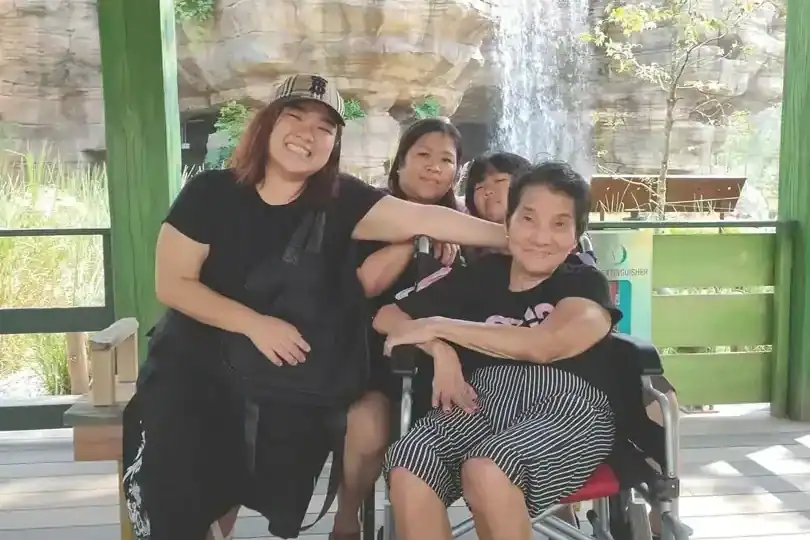
Xiumei and her family
AT THE HOSPITAL
Dr Mervyn Koh, senior consultant, geriatrician, and palliative care physician at Tan Tock Seng Hospital (TTSH), sees the knowledge gap play out daily. The most common question families ask is simply: “How long does my loved one have?”
For patients with advanced cancer, the trajectory is relatively predictable. Once they decline functionally — stopping chemotherapy, becoming bedridden — the timeframe tends to be weeks to short months. But for patients with heart, kidney, or lung failure, the picture is far less clear. Someone with end-stage chronic obstructive pulmonary disease (COPD) can be on the brink of death one week and stabilise the next. A patient with advanced dementia, bedridden and barely responsive, might survive a lung infection with antibiotics or might not. The final moment might arrive without warning. The unpredictability, Dr Koh said, is precisely what makes early conversations so urgent.
“Not knowing their loved ones’ prior preferences makes it even more difficult for families to advocate for them,” he said. He recalled a patient, a man in his sixties, unconscious in the ICU after a massive stroke. His daughters wanted the breathing tube removed. Their father had watched his brother struggle through a similar situation and had been clear: “If I were in a similar situation as your uncle, don’t prolong my suffering.” The daughters honoured that. But Dr Koh has seen the other side too. Families paralysed by guilt and conflict, unable to decide, precisely because no conversation had ever been had.
He spoke from personal experience as well. At his grandmother’s funeral, he found himself asking his parents what they would want if they became too ill to decide for themselves, such as where they wanted to be cared for, what kind of funeral, and how long they wanted it to last. “It’s the most important conversation to have,” he said. An ACP and a Lasting Power of Attorney put those wishes on record and give families something solid to hold onto when the hardest decisions arrive.
Navigating the system itself is another challenge. Hospital specialists, community teams, and home care nurses often work in parallel on the same patient, each playing a distinct role, frequently intertwined.
A Ministry of Health pilot, the Integrated Palliative Care Programme between TTSH and Dover Park Hospice, offers a glimpse of what more seamless care can look like. Home care nurses assess patients at home and arrange direct hospital admissions when needed, bypassing the emergency department entirely. For those who wish to die at home, the programme supports that too.
The programme has shown promising results: fewer unnecessary A&E visits, 85 percent of patients dying in their preferred place, and 64 per cent dying at home, against a national average of under 30 per cent.
Families are also often unaware that support extends well beyond clinical care, he sad. Medical social workers in hospitals and in the community can provide emotional and psychosocial support and carry the most comprehensive knowledge of available financial assistance. Home hospice care is currently free to access, and inpatient hospice and hospital bills are heavily subsidised. Lesser-known schemes include the Dependent Protection Scheme, the Home Caregiver Grant, and the Equipment Rental Scheme. “Ask your doctors, your nurses, your palliative care team,” Dr Koh said. “They will walk this journey with you.”
AT THE FUNERAL PARLOUR
Singapore has come a long way in its openness to talking about death, but there’s still a lag when it comes to the practicalities, said Mr Ang Ziqian, managing director of Ang Chin Moh Group.
Many people arrive with ideas borrowed from television dramas. They envision a dramatic scattering of ashes at sea, without realising the logistics involved. Others assume burial is not permitted, as cremation has become the social norm. There are other misconceptions too, like the romantic notion of ashes returned to the earth can nourish new tree growth. In reality, human cremation ashes are generally toxic to plants if applied directly or in high concentrations, as they possess a very high pH, he said.
But the more consequential gap is not factual, but communicative, he added. Parents who don’t want to burden their children say simply, “Keep it simple, no fuss.” But children who need the funeral wake and the time to grieve properly hear that and feel torn. “People think they’re disagreeing, but the underlying truth is they both want to honour the person. They just don’t know how to say it to each other,” said Mr Ang.
By the time a family walks into a funeral director’s office, they are running on no sleep and raw grief. What strikes Mr Ang most, after years of this, isn’t the grief itself. It’s the guilt that follows when no one knows what the departed wanted.
He’s seen it take many forms. A son who sought him out for six months after his mother’s funeral, sitting by Kallang River. He’d paid top dollar but was never sure it was what his late mother wanted. An uncle’s three adult children, each of a different faith, who spent hours in painful disagreement about how to send him off. “I’ve seen a lot of love, and I’ve also seen a lot of pain,” said Mr Ang.
That uncertainty drove Mr Ang to establish The Last Gift, Ang Chin Moh’s pre-planning initiative, which allows individuals to document their funeral wishes in advance, easing the emotional and financial weight on those left behind.
Beyond the funeral home, Mr Ang has spent years trying to shift the conversation more broadly through collaborations with government agencies, charities, artists, filmmakers, and initiatives like Happy Urns with the Lien Foundation.
He’s seen what preparation makes possible: An 88-year-old woman who came with her granddaughter made every decision herself and left having secured exactly the farewell she wanted. A funeral suffused with the scent of frangipani, another with a projection of a beach and open sky, was chosen by wives who knew exactly what their husbands loved.
An effective and capable funeral director, he said, is less an executor of logistics than a facilitator of something more delicate. Someone who listens not just to what a family says but also to what they mean. Who can read the room, sense the dynamics, and hold space for people who are simultaneously grieving and deciding. As every case of death is different, every approach can be different as well.
“Just as we plan for our education, our home, and our career, we should plan for our final farewell. Life is impermanent. When we plan for how we leave, we’re not just giving love to the people we leave behind; we’re giving them respect,” said Mr Ang.
“Funerals are for both the living and the departed. The goal is to leave behind love and no regrets.” Xiumei is grateful that they spoke early about her mother’s end-of-life decisions. After her mother was diagnosed with cancer, Xiumei started gentle discussions about her mother’s wishes — the kind of funeral she wanted and what should happen after she died. Her mother said she did not mind cremation. However, Xiumei found it difficult to accept the idea of having her body cremated and preferred to be buried, as she herself hopes to do in the future. Her mother eventually concurred.
Her mother eventually concurred. Today, Xiumei draws strength from walking alongside other caregivers in similar situations, offering the support she wished she had found sooner. “I know my mother will be waiting for me in heaven,” she said.
That, ultimately, is what death literacy asks of all of us: not morbid preoccupation, but practical care. To have the conversations while there’s still time and clarity to have them. To treat death not as a medical problem managed at the last moment, but as a human passage deserving the same thoughtfulness we bring to everything else we plan for in life.
Photos by: Wang Xiumei