

Talking about death is often treated as a grave, clinical event. Yet practitioners say the most meaningful conversations about grief and dying begin far more naturally — with curiosity, permission, and a willingness to listen.
How do you even begin a conversation about death?
For many people, death is still a taboo subject, too heavy to name directly. Conversations are delayed or avoided entirely until circumstances force them into the open.
Yet across hospice care, workplaces, and healthcare settings, practitioners say avoidance — or poor handling — often causes more distress. Compassionate communication is not only about saying the right thing but about how, when and whether we ask — and whether the person feels heard.
Starting at home: when “hard conversations” emerge
In family settings, conversations about death rarely happen by chance. They are usually prompted by changes that are already unfolding, said Mr Justin Tan, who works in pastoral care at St. Andrew’s Community Hospital.
A person’s condition may worsen despite treatment, hospital visits may increase, or independence may decline. Conversations can also be triggered by changing treatment goals, such as a cancer patient shifting from curative therapy to comfort-focused care, or by the patient themselves, sensing their illness is progressing. Even non-health-related life upheavals, such as leaving a job after an extended medical leave, might cause people to focus on what comes next.
The first step is permission, said Mr Tan. Rather than launching into lengthy explanations, ask if the patient is ready to talk. The “ask–tell–ask” approach gives patients and families agency, letting them share their experience before more complex medical or practical information is introduced. He also stressed creating the right moment and setting: start gently, listen with care, and let the patient guide the conversation, whether exploring daily priorities, life story, or final wishes.
“Instead of focusing on what isn’t working, we ask what gives life meaning now, emphasising hope and what matters most,” said Mr Tan.
Mr Tan recalled a case that illustrates this approach. Madam Wong*, a woman in her 60s with advanced breast cancer that had spread to her brain, had stopped eating. But her husband, Mr Wong*, insisted on artificial hydration. Clinicians spent nearly an hour discussing it with him, but he was adamant. Sensing something deeper, Mr Tan suggested a gentler approach: if Madam Wong was alert, could they try “pleasure feeding” — small amounts of clear soup offered via oral swabs so she could taste it?
The shift was immediate. Mr Wong, who previously worked in F&B, began preparing the soup himself and finally shared what he’d been holding back. Their son was overseas and estranged, and he hoped to keep his wife alive long enough for him to return. The act wasn’t about prolonging life but an expression of his love language and unfulfilled wishes.
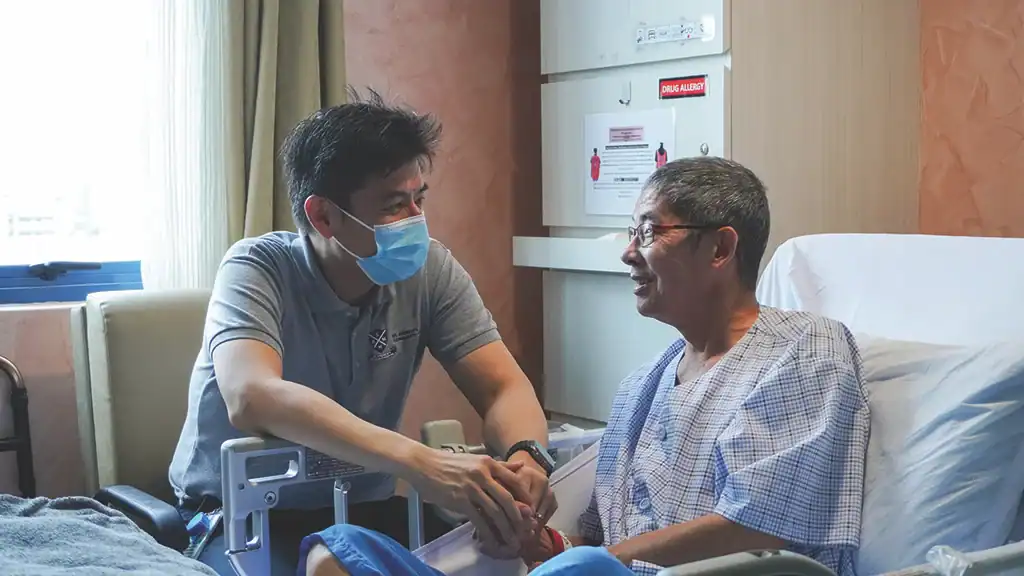
Family dynamics can complicate these conversations, said Mr Tan. Clarity helps. Identify the decision-maker if the patient lacks capacity, while acknowledging others’ perspectives. Anchoring discussions in the patient’s values and goals, and maintaining consistent messages across the care team, prevents confusion. Strong emotions — grief, anger, denial — occur frequently and should be handled with empathy and guidance of the family toward rational decisions aligned with the patient’s wishes.
Having seen his wife’s suffering during chemotherapy, Mr Wong — later diagnosed with advanced lung cancer — did not want aggressive treatment. His son, burdened by guilt over missing his mother’s final days, initially disagreed. In the end, they agreed on the best supportive care and later took a road trip to Malaysia together.
“These conversations are essential,” Mr Tan said. “They’re part of high-quality care.”
Grief at work
If conversations about grief are difficult at home, they can feel even more fraught and confusing to navigate at work. Workplace hierarchies and professional expectations often leave colleagues unsure how to respond, said The Compassionate Network Executive Director Ms Wai Yee Chee.
One common misunderstanding is assuming that keeping a grieving employee busy will help distract them. Others flood the person with well-meaning but incessant questions. Some attempt to erase reminders of loss by quickly packing away a deceased colleague’s belongings or removing their name from mailing lists. Even a hug from a senior leader who is not close can feel intrusive.
“These actions are often meant to help,” Ms Chee said. “But they can feel dismissive or even triggering to someone who is still processing the loss.”
Context matters. The nature of the death, the closeness of relationships, and the visibility of the event shape what feels appropriate. Ms Chee recalls working with a woman whose husband had drowned — a traumatic death that became public news. When she returned to work, colleagues’ curiosity compounded her distress.
Supportive workplaces start with thoughtful systems, said Ms Chee. Clear communication from the Human Resources department about leave options and workplace policies helps bereaved staff regain a sense of control. Immediate supervisors can make a difference simply by asking, “How would you like us to support you when you return?”
Having a designated “buffer” — someone who shields the grieving employee from unwanted attention and communicates boundaries to the team — can be transformative. Practical accommodations, such as flexible workloads, safe spaces for privacy, and permission to step away when emotions surface, go a long way.
Long-term support matters too. Organisations that offer flexible work arrangements, unpaid leave when necessary, or subsidised access to therapy ensure that employees are not forced to choose between work and care, or that their mental health suffers as a result. As Ms Chee put it, “The culture of flexibility, the generosity of the bosses to say, ‘If you need no-pay leave, go for it,’ and sharing out work where needed or bringing in a contract staff — all these are helpful.”
Ms Chee mentioned the example of a hedge fund firm that handled the death of a senior staff member with exceptional care. She assisted the company in creating a discreet remembrance space with flowers, candles, and photos and engaging staff in collective rituals — a minute of silence to sharing memories — with even colleagues abroad participating via Zoom.
Practical matters were handled thoughtfully. The team closest to the deceased helped decide who would take over the staff member’s role and how to handle their belongings. A close co-worker personally returned items to the family in a way that avoided causing further grief. Employees could also seek counselling from Ms Chee, even months later, as the senior leaders recognised that grief unfolds on different timelines.
“The overall approach was consultative and revolved around giving people options,” said Ms Chee, who is also a member of the International Workgroup on Death, Dying and Bereavement.
Not all workplaces are so supportive. Ms Chee recalled a mental health agency where a staff member had died by suicide. Senior leadership wrestled with stigma and hesitated over whether colleagues could seek support, even as some had already reached out to her individually.
“When workplaces aren’t supportive, we have to guide the bereaved on how to navigate the office,” she said.
Ms Chee pointed out that small systemic changes can make a big difference. Currently, compassionate leave is not a legal obligation, and while many companies offer two to five days, insisting it be taken consecutively can be limiting.
Flexible leave allows staff to address practical matters, such as updating flat ownership and managing legal or estate matters. As Singapore’s families become smaller, more employees may grieve for people who are not immediate relatives, she added, so workplace policies need to reflect that reality.
In healthcare: shifting the mindset
Many healthcare providers would describe conversations about serious illness as “difficult”. But that label itself may be part of the problem, says Associate Professor Alethea Yee, director of education at the Lien Centre for Palliative Care (LCPC), Duke-NUS, and senior consultant in the Supportive and Palliative Care division at the National Cancer Centre Singapore.
“Clinicians talk to patients and families all the time, so why should their interactions be any different?” she said. “When we reframe these discussions as conversations about what matters to the patient and family — not just about death and dying — they become more natural and much less intimidating.”

Understanding what truly matters to patients, she explained, allows clinicians to make recommendations that are better aligned with patients’ values, leading to more meaningful and informed healthcare decisions.
In Singapore’s “pragmatic, outcomes-driven” healthcare system, there is often a strong emphasis on measurable indicators, such as the completion of Advance Care Planning (ACP), she said. While important, A/Prof Yee notes that this focus can unintentionally push clinicians into having conversations that feel rushed or poorly timed.
“When we only concentrate on end-of-life outcomes — whether someone wants cardiopulmonary resuscitation, comfort care, or limited interventions, or where they want to be cared for at end-of-life — we miss the heart of the conversation,” she said. “Those decisions matter, but they shouldn’t be the starting point. The first step is understanding patients as people, so they feel heard and supported. Most patients are open to talking about the future, but only after they feel cared for in the present.”
LCPC has trained more than 1,500 healthcare professionals in Serious Illness Conversations (SIC). The course offers clinicians a patient-tested framework and language to guide these discussions. What they teach is a guide, not a script, A/Prof Yee explained.
For conversations to be humane, clinicians must integrate empathy and core communication skills. The framework simply gives them a safe place to start.
“I often ask, ‘What gives you strength to get through this?’” she shared. “Some patients cry because no one has ever acknowledged how brave they are. Living with serious illness requires enormous courage. We need to recognise that and help patients identify the inner resources they can draw on.”
Over four years of running SIC workshops, LCPC has received invaluable feedback from clinicians. Many report that patients are far more receptive than expected — some even saying they have never had a clinician speak to them in this way before.
Clinicians also describe how shared decision-making becomes easier, and planning for uncertainty feels less overwhelming.
At National University Hospital, the heart failure team integrated SIC into routine care and saw ACP completion rates rise as a result. A/Prof Yee also observed that nurses, who often spend the most time with patients, frequently become the strongest advocates for this approach.
LCPC will be running a pre-conference SIC workshop at the upcoming Singapore Palliative Care Conference 2026, training local and regional clinicians in these skills.
But A/Prof Yee is clear that education alone is not enough. There is a need for more systemic changes to make these conversations possible. This includes standardised documentation in electronic medical records, longer appointment slots, appropriate incentives, and tools like AI-assisted questionnaires to help patients reflect before consultations.
Equally important, she added, is raising public awareness so that patients and families themselves begin to expect and request these conversations.
“With an ageing population and rising rates of chronic serious illness, if we truly believe in person-centred care, then serious illness conversations are not optional,” A/Prof Yee said.
Not one conversation, but many
Across settings, one message is clear: conversations about grief and dying are not one-off events. They should be bite-sized and ongoing because not everyone can handle heavy talks all at once.
It’s less about saying the perfect thing and more about listening: asking instead of assuming, letting silence, emotion and uncertainty exist without rushing to fix or judge. And simply being present — holding hands, offering a reassuring touch, or sitting in quiet.
Mr Tan reflected that at the end of life, four things often matter most: love, forgiveness, appreciation, and farewell. Creating space for those exchanges takes courage and gentleness.
“I hope people have more courage to talk about death and dying,” he said.
Photos by: Ms Chee Wai Yee, Lien Centre for Palliative Care, St. Andrew’s Community Hospital